Calypso It Aint Far Again Just Day
What a pirate festival, and dancing lone to Calypso, can teach the states about the here and now.
 People who similar to play tricks themselves out in pirate attire and drink a lot of rum and beer accept over California'due south Catalina Island during an annual festival called "Buccaneer Days." I learned this when a man I was seeing a few years ago took me on a date to Catalina; he thought information technology would be romantic in an adventuresome sort of fashion for us to snorkel the cold, slightly forbidding waters off the island'south declension. It was a not particularly sunny Oct day and the early morning ferry we boarded at San Pedro was non too crowded. We didn't expect to meet many people on Catalina. There was no doubting, though, equally the ferry docked at the village of Two Harbors, that we had been mistaken: there were going to be a lot of people on Catalina. Many of them would be wearing a patch over i heart.
After disembarking, we escaped the crowd and napped on a cliff on the other side of the island, ate lunch, rented wetsuits and an outboard, rode the boat to an outcrop, snorkeled around the rock for no longer than an hour, and before catching a ferry dorsum to San Pedro, managed to take hold of seats at a bar where the pirates were gathering. The bay at 2 Harbors was by this fourth dimension packed with boats, and the bar and its patios were crammed with people whose pirate renderings showed trivial variation: middle patches, striped shirts, torn shirts, and—there were misfires—tricornes that appeared more colonial than flamboyant in design were everywhere to exist seen. Enough of women were scantily clad; at that place were many an flood bust on Catalina that 24-hour interval. But then so many themed events invite that sort of affair.
As we watched the crowd beverage, shout, and jostle each other about, a dancing man and woman caught our attending: the man wore a patch, a three-cornered hat, and then on; my memory of the woman'south attire is obscured by the thick rope that coiled around her waist and stiffly leap her arms to her dorsum. (That the woman was black and the man was to all appearances white was not lost on me. Intentionally or not, they evoked something more than plain old pirating.) She danced despite her restrictions, swaying from side to side, seemingly content—serene, even—in the role of captured booty. Simply as nosotros were leaving, her dance partner tied her to the trunk of a tree.
The shipping cranes and barges our return ferry passed as it navigated San Pedro's night channels looked exquisite in the night. Giant headlamps shed precipitous light on tall, brightly painted industrial structures and massive, hovering containers. Later a few hours with so many pirates immersed in some vague and afar seafaring era, the scene offered reassurance. No square-rigged frigates in the San Pedro channels—just magnificent aircraft machinery, the stuff that moves economies. Yes, I remember thinking, this is where nosotros are.
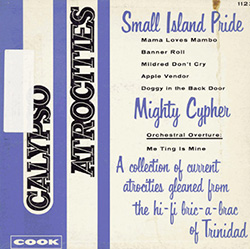
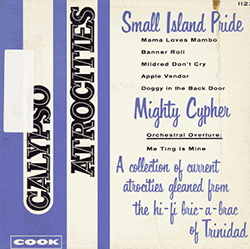
I idea of Buccaneer Days and the happily bound adult female as I danced around my living room this by New year's day'southward Eve. I'd bagged on a program to travel out of boondocks and, a little wearied from a busy month, couldn't imagine existence enjoyable company to the friends who invited me to join them here in New York. I decided to spend the night at home with a good meal, a good canteen of wine, and music that I similar. About 2 hours before midnight, I downloaded two albums—Calypso Awakenings and Calypso Atrocities—and put together a playlist.
My retentiveness of the woman's attire is obscured by the thick rope that coiled around her waist and stiffly bound her arms to her back.
Both Awakenings and Atrocities collect performances by mostly obscure calypsonians recorded in the late nineteen fifties and early nineteen sixties by the American sound engineer Emory Cook. Cook traveled throughout the Caribbean area—particularly Trinidad—and North America in search of ambience and evocative sounds: thunderstorms, carousels, trains heading toward Manhattan on the tracks of the Primal Hudson Line, coffee percolating, and loftier-spirited calypsonians playing to crowds in what I imagine to have been sweltering Port of Espana halls, to name a few of his Melt Records tracks. A 1956 New Yorker profile of Cook explains that he had a special interest in what Daniel Lang termed "nostalgic sounds." It was a far-reaching nostalgia that Cook had in listen; he believed that sound has the ability to summon not only private memories—of being placed on a carousel equus caballus by a parent or of a weekend trip to the city from upwards the Hudson, for instance—simply besides, as Lang puts information technology, "the very origins life."
At the time the contour was written, Cook had plans to travel to Nova Scotia to visit a cave in which the acoustics were said to be unique: he'd heard that h2o dripped from the cave'southward ceiling to its floor in a "deafening serial of plops." He offered Lang a curious explanation for wanting to tape the sound of the dripping water: "It could tap the racial unconscious. This isn't only ordinary nostalgia we'll exist dealing with. This is direct atavism. From the cave to the present and back again. It may be the psychological scoop of the century!" Melt suspected, in other words, that the sound of dripping water is so deeply engrained in the human unconscious that we might, in hearing a good recording of those drips, exist brought back to our earliest memories as a species.
Cook was so entranced by Trinidad's music—the Melt Records catalog is dominated by recordings of the island'southward calypsos, steel drums, and kalindas—it'southward like shooting fish in a barrel to imagine that he heard in it, too, something essential, something that might send listeners if not to the cave and then at least to some distant point in their shared history. And, of grade, back to the present again.
I'd wondered just earlier that twenty-four hour period—as I exercise when I'one thousand bored with my music—what songs, what albums I would fall in dearest with next. Future obsessions are such mysteries. What volition the next political intrigue be? Next natural disaster? Next love? Adjacent good news? Adjacent bad? Difficult to say. I certainly couldn't accept guessed a few weeks prior that I would listen to calypsos on New year's day's Eve. Despite a genealogy that might suggest otherwise (my father is Trinidadian, as are my mother's parents), I don't very much like calypso. For all its political overtures, the music's melodies are likewise frequently likewise beautiful for my ears. I don't know whether information technology's the influence of the officers stationed at American armed services bases in Trinidad during and after World War II or what, simply something had happened to the music by the time the Americans relinquished control of the major naval base at Chaguaramas in 1963—I remember of it as a dilution of earthiness, of something substantially Trinidadian—and I'm non certain it ever recovered. (Jamaica, which hosted, as far as I tin tell, only one remote American air field and 2 small naval bases during the state of war and non for very long after that, doesn't seem to take had so much of this problem with its master musical export.) The Mighty Sparrow, maybe the best known of the calypsonians to emerge from postwar Trinidad, is more than famous than his early-career rival Lord Tune, whose rhythms were so much more playful and whose lyrics were so much more charmingly self-deprecating than Sparrow'southward, speaks, I think, to calypso'southward relative failure as a genre.
Only I'd seen my paternal grandmother over the holidays. Hearing her talk in her beautifully thick, sing-songy accent and make jokes—jokes that have go more and more than vulgar as dementia has prepare in and that audio somehow distinctly Trinidadian to my ears (to the nurses who encourage her to use the bathroom subsequently she hasn't gone for a while, she is said to have once shouted in irritation, "What?! Yous want me shit for sell?!"; to an elderly man staring innocently into space every bit she passed him in a nursing home hallway, "Y'all think you're important? You lot're not of import! Yous're IM-PO-TENT! You will never ascent again!")—made me a little nostalgic for Trinidad and hell, fifty-fifty calypso. Information technology can, at least, be a lyrically clever music.
After the playlist looped a few times, I whittled it down to only two tracks—one from Atrocities and one that appears on both Atrocities and Awakenings—performed past a man who went by the not-also-apprehensive stage name of Lord Commander. (Non that information technology'southward an unusually bold name. Lord Commander, Lord Melody, Lord Kitchener, Lord Executor, Lord Beginner, Lord Pretender, Lord Observer, Lord Invader, Lord Shorty, and the listing goes on: Trinidadian musicians of the nineteen forties and nineteen fifties borrowed freely and humorously from the titles of their British rulers.) Lord Commander—known variously every bit Mr. Action, Mighty Commander, and just evidently Commander—is described in the Awakenings liner notes every bit having had an eccentric performing way. I doubtable he earned this reputation by being—as Lord Pretender recounts in Hollis Liverpool's oral history of calypso, From the Horse'southward Oral fissure—among the starting time calypsonians to dance on stage. Apparently, Commander used to tap trip the light fantastic toe on street corners for money when singing did not earn him plenty to live on. This boosted talent didn't serve him for very long: Commander died in squalor, rummaging the garbage bins of San Juan, Trinidad.
The audio of dripping water is and then deeply engrained in the man unconscious that we might, in hearing a good recording of those drips, be brought back to our earliest memories as a species.
During his performing years, Commander was an eccentric and an incisive lyricist, and these qualities are easy to observe in "No Crime, No Law," a song that inspired Derek Walcott to compare Commander's brand of irony to that of the High german poet Bertolt Brecht. I can't speak to Brecht comparisons, but I exercise hear in "No Crime, No Law"—and even more so in his Atrocities track "You Can't End Pleasing People"—not only an unexpectedly appealing form of the billowy American rhythms that had by this time infused calypso (in both songs, Commander is backed by what sounds near similar a barbershop quartet), but also a hearkening back to the earthiness and unpredictability I miss in most calypsos. Perhaps information technology's not and then surprising to hear both sounds in songs recorded before Americans had fully taken their leave of Trinidad, and as the island began to seek independence from Britain. What is surprising—at to the lowest degree at offset idea—is that I hear in these songs an anticipation of what was to emerge in the afar Bronx two decades after: rap—which takes every bit its oldest source the vocal arts of ancient West African griots, the wandering vocaliser-poets from whose canards and incantations calypso, besides, is widely understood to take emerged.
In "No Crime, No Police" and "You Can't Finish Pleasing People," Commander sounds in tempo and lyric equally if he is barreling toward the Bronx in an ancient vessel. Yous tin can almost hear it in the lyrics to "No Law-breaking, No Police":
I desire the government of every country
Pay a criminal a big bacon
And when they commit a crime
The police force shouldn't give them any long time
A police should be glad when one twist a jaw
Lock a neck, buss a face, or pause open a shop
He should exist merry when somebody violate the law
For that is what the government is paying him for
But if somebody don't bosom somebody face
How the policeman going to make a case?
And if somebody don't lick out somebody middle
The magistrate won't take nobody to try
And if somebody don't kill somebody dead
All the judges got to beg their bread
So when somebody cutting off somebody head
Instead of hanging, they should pay them coin instead
It's similar a jungle sometimes.
In "You Can't Stop Pleasing People," Commander abruptly stops his rap-like cadences to shift—his vocalism even wavers and cracks—to a melodic barbershop chorus (that ends in a raucous line: "To hell with everybody!"), but to fall back into a careening rap. He sounds as if he's straddling genres and eras; I can almost imagine him tap-tripping right and left across the stage as he bellows and sings.
Of course, I didn't know or recall about all of this equally I listened to Commander over and over on New year'southward Eve, dancing around my living room until I was dizzy. What did begin to accept shape in my listen that dark was the idea that Commander held the same place in my imagination on New year's Eve that pirates held in the imaginations of the revelers at Catalina Island. Yes, Buccaneer Days is at heart an opportunity to go drunk. For those who took the opportunity a stride further and made themselves physically uncomfortable for the occasion, there was something more going on. Something kinky, certain. But the adult female bound to a tree—and her captor—must have found more appeal in the event than mere kinkiness tin offer. I imagine that what they sought and found is a take a chance to locate the present in an image of the past.
Isn't that really what I saw along the San Pedro channels—non the reassuring present, only an epitome of the industrial by? Steel, the ghosts of longshoremen? Isn't that what I hear in Commander'due south cadences, in my grandmother's voice, in her sense of sense of humour? Something erstwhile and essential. A griot, peradventure, the one who whispered equally I stood listening to Commander on the roof of my building at the turn of the twelvemonth. This is where nosotros are.
Suzanne Menghraj teaches writing in New York University's Liberal Studies Program. "Buccaneer Days" is the second in a 6-part serial of essays Suzanne will write for Guernica with support from a Liberal Studies faculty grant. "Twin Peeks", the series's kickoff essay, appeared on Guernica in February.
At Guernica, we've spent the final 15 years producing uncompromising journalism.
More than than 80% of our finances come up from readers similar you. And we're constantly working to produce a magazine that deserves you—a magazine that is a platform for ideas fostering justice, equality, and civic action.
If you value Guernica'due south role in this era of obfuscation, please donate.
Help the states stay in the fight past giving here.
mccormicksprientake.blogspot.com
Source: https://www.guernicamag.com/calypso_awakenings/

Post a Comment for "Calypso It Aint Far Again Just Day"